
Bio
California-based artist Nancy Rubins (b.1952) is a pioneer of monumental, gravity-defying sculpture installations made from massive quantities of found objects. In 1974 she completed a BFA at the Maryland Institute College of Art in Baltimore and then moved to the West Coast to study at the University of California at Davis, where she received an MFA two years later. Around this time, she began salvaging used electric appliances and fusing them into semiflexible, wall-like structures. By the 1980s and 1990s, Rubins expanded both the physical scale and structural ambition of her work, as she suspended and cantilevered massive components in equilibrium, including hot water heaters, mobile homes, mattresses, and eventually airplane wings and fuselages in her sprawling Airplane Parts series.
By the 2000s, Rubins introduced canoes, kayaks, and boats, arranging them into airborne clusters that towered over public sites such as New York City's Lincoln Center and The Museum of Contemporary Art San Diego. This series has continued into the present day with variations permanently installed in Crystal Bridges, AK and The Buffalo AKG, among other locations worldwide. Rubins’s concern with movement and spatial tension continued into the series Our Friend Fluid Metal in the early 2010s, where colorful postwar playground spring animals and amusement-ride figures are bound together with stainless-steel cables. Later that decade, she developed Diversifolia and Fluid Space, with cast aluminum and brass animal forms whose limbs and contours become baroque lineaments. Across these evolving series, Rubins considers the lifecycle of her materials, emphasizing their formal qualities while rendering them in abstract tensile configurations that underline their mutability.
Drawing and collage are also integral to Rubins’s practice, functioning both as an independent medium and as a conceptual analogue to her sculpture. Since the 1970s, her relief-like graphite drawings have built dense, reflective surfaces that evoke liquid metal and spatial depth through layered, physical mark-making. This dialogue extends into her collage works, where cut photographic fragments of boats or animal forms create hybrid abstract compositions that echo her sculptures. Together, these practices reveal solid forms as contingent, shifting arrangements. Rubins’s work is held in major public collections including the Museum of Modern Art, the Whitney Museum of American Art in New York, Landmarks at The University of Texas at Austin, and the Museum of Contemporary Art in Los Angeles. She has lived and worked in Topanga, California for the last 40 years.
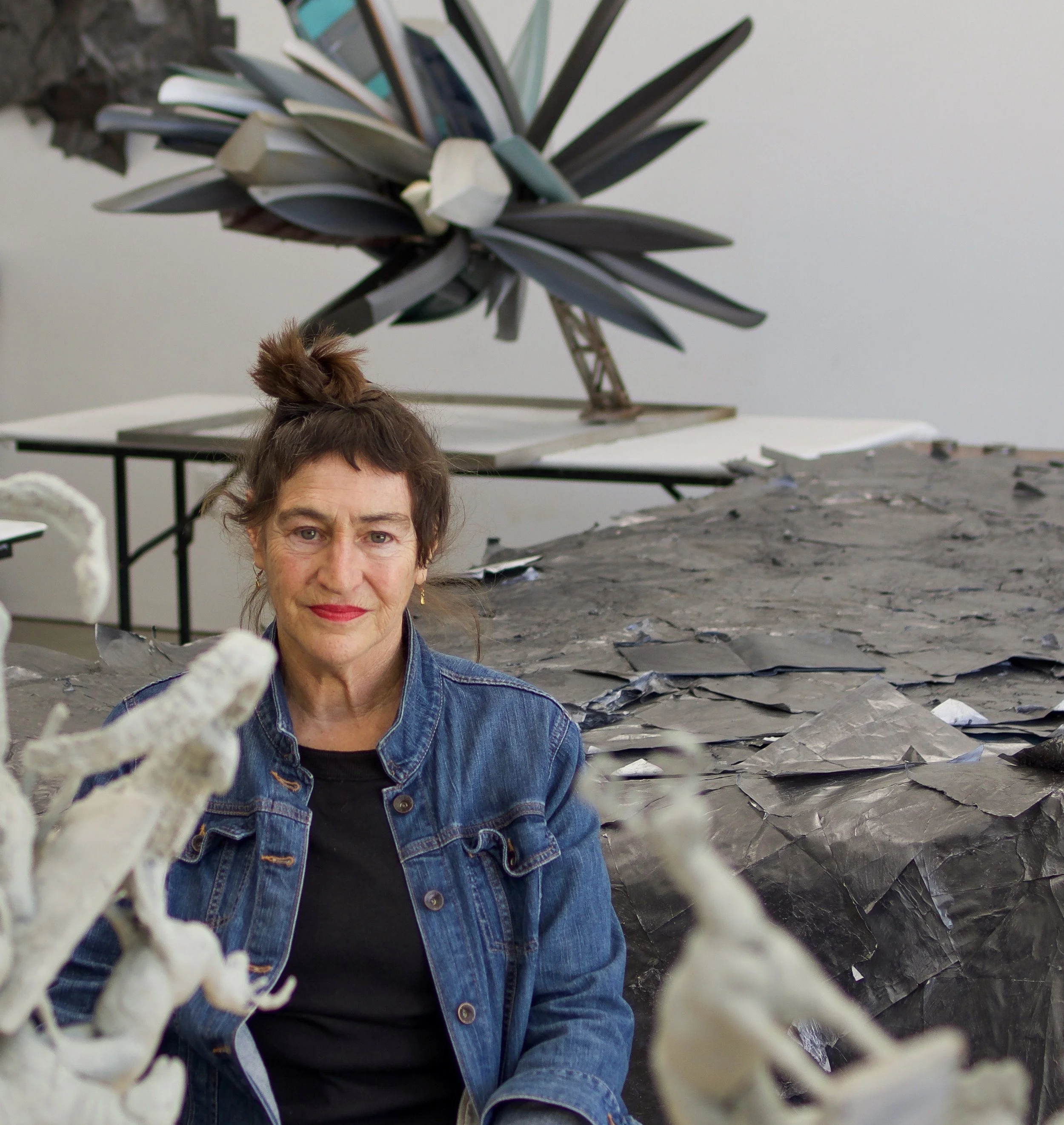
Photo credit: Joel Searles